
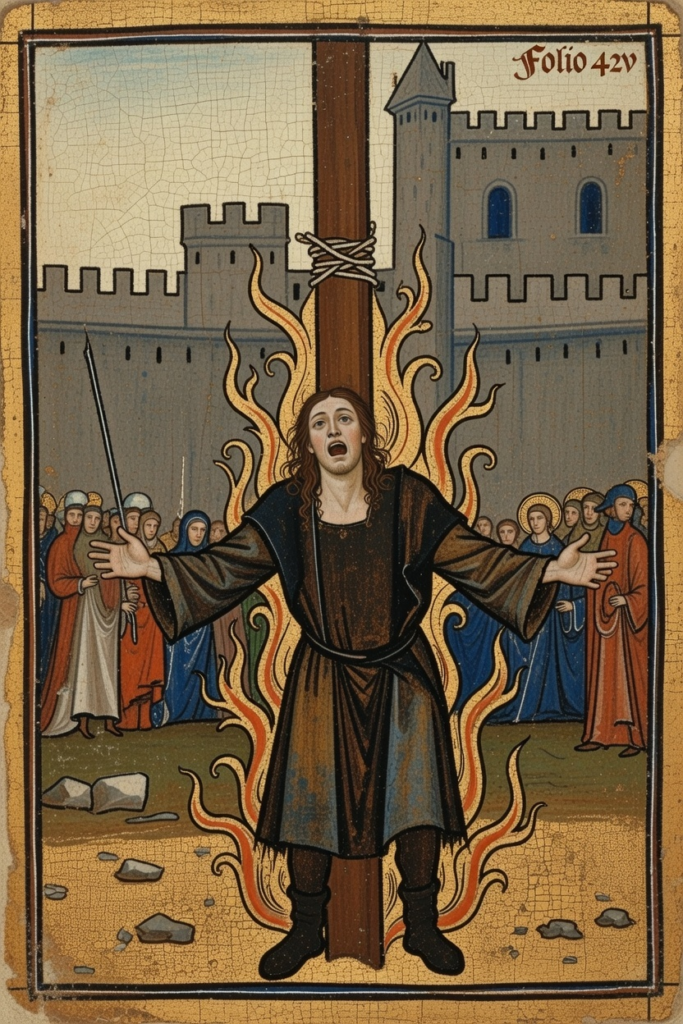
Some people claim that Calvin “executed heretics.” That statement oversimplifies the historical reality in at least two important ways:
- It was the State, not the Church, that carried out the execution of heretics.
- The punishment of heresy by civil authorities was widely accepted across almost all of Christian history — until relatively recently.
To understand this, a brief historical overview is necessary.
The Early Church (Pre-Constantine)
Before the Council of Nicaea (325), the early Church Fathers said essentially nothing about how the State should handle heretics. Writers such as Tertullian, Lactantius, and Origen emphasized that faith cannot be coerced, and opposed forced conversions and religious compulsion.
However, their relative silence about the role of the State in handling heretics was likely due more to circumstance than to settled principle. At the time, Christians were a persecuted minority. It is highly doubtful they imagined a future in which a State — much less the Roman Empire itself — would identify as Christian. Asking the early Church fathers for a developed opinion on the State’s punishment of heretics would be like asking a medieval lawyer for a legal analysis of copyright law before the invention of the printing press. To say it was not on their radar would be an understatement.
After Christianity Became Imperial
Everything changed under Emperor Theodosius I, when Christianity became the official religion of the Roman Empire in 380 AD. In a world where everyone believed that the king got his authority from God and had a duty to serve the Church, the question of handling heretics eventually became unavoidable and no longer the exclusive domain of the Church: What should the State do with heretics in a Christian society?
By the late fourth century, heresy was criminalized under imperial law. While there were debates about freedom of conscience, there was far less disagreement about the public teaching of heresy. Teaching heresy was seen not only as spiritually dangerous but socially destabilizing, and the government had a God-given duty to maintain social order. After all, God gave the government “the sword” to keep peace in the land (Rom 13:1-7).
The general pattern that developed was this:
- The Church investigated and determined whether heresy was being taught.
- If a person persisted after correction, the Church excommunicated him.
- The individual could then be handed over to civil authorities.
- The State — not the Church — imposed civil penalties, which could include exile or execution.
There were exceptions and variations, but this was broadly the dominant model in Christian Europe for well over a thousand years.
The Roman Catholic Church
In the medieval period, the Roman Catholic Church formalized its procedures through the Inquisition. Over time, however, the Roman Catholic church’s position changed.
By 1965, Vatican II’s Dignitatis Humanae (Declaration on Religious Freedom) affirmed that religious coercion should cease. But even long before that formal statement, executions for heresy had become rare. In Evangelium Vitae (1995), Pope John Paul II described cases justifying capital punishment as “very rare, if not practically nonexistent.”
The last execution carried out in connection with the Spanish Inquisition was that of Cayetano Ripoll, a schoolteacher hanged in Valencia in 1826 for allegedly teaching Deism and neglecting Catholic mass.
Today, the Roman Catholic Church does not advocate the execution of heretics.
The Early Protestants
The early Reformers — Luther, Zwingli, Calvin, and others — also lived in a world where church and state were understood to need to be necessarily intertwined. They regarded persistent, public heresy as a threat both to the Church and to social order, and believed the government had a duty to maintain social order.
Like their Catholic counterparts, they generally believed that the Church should judge doctrinal error, and that the civil magistrate had authority to punish serious public offenses, which could include heresy. Exile or execution were considered legitimate civil penalties in extreme cases.
It was not until the Enlightenment that Protestant thinkers began systematically opposing religious coercion. John Locke’s A Letter Concerning Toleration (1689) argued forcefully that civil magistrates should not punish purely religious errors. By the late 17th and early 18th centuries, most Protestant traditions had abandoned the practice of turning heretics over to civil authorities for execution.
Today, no mainstream Protestant denomination teaches that heretics should be executed. Some even oppose capital punishment altogether.
The Anabaptist Exception
The major exception in the 16th century was the Anabaptist movement. From its beginnings in the early 1500s, it rejected the union of church and state. Anabaptists were pacifists who sought to take the Sermon on the Mount literally.
They rejected:
- Participation in war
- The use of coercion in religion
- Christian involvement in government
- Capital punishment in all forms
They believed the state acted outside biblical teaching when it executed anyone anywhere at any time — whether for murder or heresy. Modern Amish, Mennonites, and Hutterites trace their heritage to this stream of Christianity.
Conclusion
It’s no surprise that history on this topic is more complex than popular anti-Calvin slogans suggest. And what modern Christians in the West fail to understand is the close union of Church and State that everyone everywhere accepted for well over 1,000 years. Whether one agrees with past Christian practice or not, it is difficult to deny that for most of Christian history — Roman Catholic, Eastern Orthodox, and Protestant alike — civil punishment of all forms of sins, including heresy, was considered legitimate. Only in the last few centuries has that consensus substantially changed, and that change is not owing to exegesis of Scripture, but rather, the influence of Enlightenment thought (especially for the West). On the specific question of whether or not the State should prosecute heresy, Scripture is silent either way.
I find that historical development rather interesting.
Thought you might as well.
Leave a Reply