
The heavens declare the glory of God, and the sky above proclaims his handiwork. Day to day pours out speech, and night to night reveals knowledge. There is no speech, nor are there words, whose voice is not heard. Their voice goes out through all the earth, and their words to the end of the world. – King David, Psalms 19:1-4
People often look at these verses in Psalms 19 and say “Hey! Check out God’s handiwork in nature: Rabbits reproducing according to the Fibonacci sequence; pineapple rinds and daisies petals following mathematical patterns. See! Nature is showing us God’s glorious handiwork, just like Ps 19 says”. While that’s all fine and good, I’d like to propose that “the heavens declare the glory of God and the firmament shows His handiworks” can be reasonably taken to an all new level. And I’m not alone in this aspiration: If I’m reading him right, when Paul quotes this passage in Romans 10:18, he’s using it to say that the heavens declare the Gospel – not just general revelation of Himself – to the whole world. Start in Romans 10:9 and read through to v18 and you’ll see what I mean. It’s one thing to use Psalms 19 to argue for General Revelation or Intelligent Design; it’s quite another to use it to argue for the Gospel! So what on earth could Paul mean, and how does he come to quote Psalms 19 in ?
Some Loopy Background Information
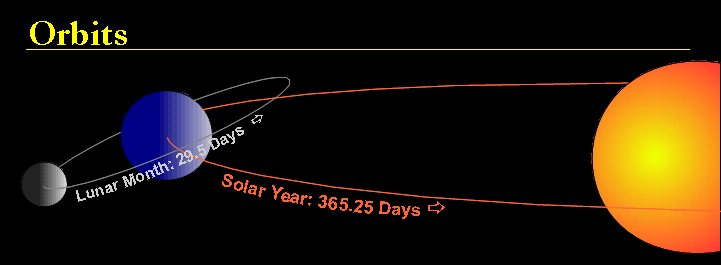
I have a theory about how one uses Psalms 19 to get to the Gospel, but to get there, some background information is necessary. Take a look at the following diagram of the earth, sun, and moon, and let’s discuss the following items.
(if your eyes glaze over, just jump to the last paragraph of this blog):
- The Moon’s orbit (synodic) around the earth is 29.5 days. This cycle is called a “lunar month”, and 12 lunar months make one “lunar year” (approximately 354 days).
- The earth’s orbit around the sun is 365.25 days, and we call that a “solar year”. The fact that our planet is 22 degrees off-axis gives us 4 different seasons as the earth orbits the sun.
- Each solar year (365.25 days) is slightly longer than 12 lunar months (12 months x 29.5 days = 354 days), so the lunar year is 11-ish days shy of a solar year.
- Most countries in the world follow the Gregorian Calendar, first introduced by Pope Gregory XIII in 1582. It’s a collection of 12 months of arbitrary lengths (usually around 30 days each), arranged so that 12 months equals one solar year. Every 4 years, an extra day is added to the year to keep the calendar fixed to the seasons. As with all solar calendars, the Gregorian Calendar doesn’t pay any attention to the lunar month, so the day of any given month has no correlation to the cycle of the moon. The average man doesn’t know or care when the New Moon or full moon takes place. Geeks, astronomers and astrologers (the only ones who do care) can look up such things on a chart or on a smartphone app if they want to know about lunar cycles.
- In ancient cultures, lunar calendars were more common than solar calendars. With a lunar calendar system, each New Moon starts a New Month, and the seasons are not fixed to the calendar. By way of example, the modern Islamic religious calendar is a lunar calendar, and the month of Ramadan slides across the seasons from year to year. In the year 2010, the month of Ramadan was Aug 10 – Sep 9. In 2020, Ramadan was April 23-May 23. In 2030, it’ll be Jan 5-Feb 3.
- Around 450 BC, the Greek philosopher Meton of Athens observed that the lunar calendar and solar calendar could be harmonized by adding an extra 13th month every 2-3 years. This harmonization resulted in a 19 year luni-solar calendar cycle of twelve years of 12 lunar months and seven years of 13 lunar months.
Now that we’ve got some calendar basics squared away, we can turn our attention to the one culture whose calendar stands apart from all the rest: the Hebrew calendar.
The Hebrew Calendar
The Hebrew calendar is a luni-solar calendar with a very peculiar history. It’s present form can be traced as far back as the 4th century AD when a rabbi named Hillel II modified the existing Hebrew agricultural calendar in order to maintain unity and consistent observance of festivals for Jews scattered across the diaspora. The exact origins of the Hebrew calendar prior to Hillel II unknown, but there is strong evidence in rabbinical writings that it was in use as far back as Moses in Exodus 12:1. Using an Early-Date Biblical chronology, that places the Hebrew luni-solar calendar as far back as 1446BC, one thousand years before the Greeks discovered it.
The peculiar thing about the original Hebrew calendar is that instead of using math to synchronize their calendars like Meton did, the Israelites used their Spring Feasts to know when to insert their intercalary month into their year to form their leap year. You can read all about their feasts in Leviticus 23 (and their related passages in the Pentateuch), but you’d never realize that the implementation of these feasts automatically reconciled the solar and lunar calendars unless you put 2 and 2 together using a bit of extra-Biblical information from ancient rabbinical writings. To get that data under our belt, we need a brief primer on the Spring Feasts in the Bible.
The Feasts of the Lord (Spring Feasts)
In Leviticus 23, God commanded the Israelites to celebrate seven annual “Feasts of the Lord”. The first four were in the Spring and focused on spring planting and harvests. The last three feasts were for the fall harvests. Here’s a quick list of the Spring Feasts and when they were celebrated:
- Feast of Passover: Celebrated on Abib 14 (the 14th day of the first month). Symbolizes the death of the Lamb of God, dying to take away the sin of the world. (John 1:29)
- Feast of Unleavened Bread: Celebrated from Abib 15-21. Symbolizes the sanctifying work of Jesus Christ who cleans us of our sins. (1 Cor 5:7-8)
- Feast of First Fruits: Celebrated on the first Sunday after Passover. Symbolizes the resurrection of Jesus Christ and the promise that we, too, will one day be resurrected, just as He was.
- Feast of Weeks: Celebrated 50 days after First Fruits. Symbolizes the readiness of the full harvest when the whole crop is resurrected and ready for Him. (1 Cor 15:20-24)
Here’s how it worked: The Feast of First Fruits required a fresh, ripe bushel of barley to be presented to the priest on the first Sunday after Passover in the first month of the year. That month was named “Abib”, which in Hebrew means “first ear”. It refers to the stage of barley where kernels have formed in the “ear” of the stalk, but are still soft. This only occurs in early spring (March/April).
So on or around Passover day, the farmer would walk out into his field looking for a fist-full of barley that would serve as the first fruit for the next Sunday’s Feast of First Fruits festival. If the barley harvest wasn’t ripe enough by Passover, then instead of calling that month the 1st month of a new year, it was called the 13th month (Adair I) of the previous year, thereby postponing the new year and its required feasts for another month. This reset would force the Spring Feasts to always begin in the first month of the year and thereby keep the seasons in sync with their calendar.
An Extra-Biblical Metaphor
If the reconciliation of these calendars based on a first fruits sacrifice doesn’t seem amazing to you, consider this possible metaphor:
- The sun is the source and giver of energy, light and life. Without exception, all life on earth is directly or indirectly sustained by the sun.
- The moon is apart from the sun, spinning on its own particular orbit, indifferent to the sun. It is dead, has no life, gives no light, gives no energy. The only light it does give is merely a reflection of the living sun. (Granted, the Bible does not get into symbolism of the sun and moon representing God or Man, but as a metaphor, it is is not an unreasonable metaphor.)
- The required feasts (Lev 23) which reconciles the (dead) moon calendar to the (living) sun calendar is the combination of the Passover Feast, the Unleavened Bread Feast and the Feast of First Fruits. These 3 feasts happened in the first month of the year (Abib), in the middle of the month. These 3 feasts, in combination, when performed as prescribed by God, forced the Jewish lunar calendar to be reconciled with the solar calendar.
Imagine that: death (moon) reconciled to life (sun) because of Christ’s resurrection! And it’s choreographed in the heavens!
Music To My Ears
Let’s take this calendar fun to a whole new level.
- In our solar calendar, we use a 4 year pattern of 3 regular years (365 days) and one leap year (366 days) to keep the four seasons in sync with the 365.25 day solar calendar.
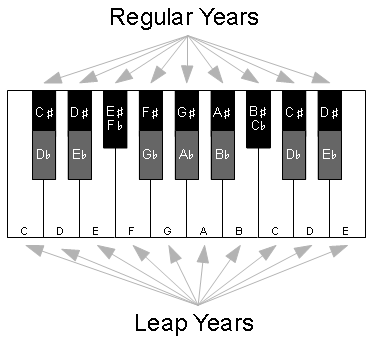
- As pointed out above, the Hebrew lunisolar calendar features a 19-year pattern of regular years and leap years, where every 2nd or 3rd year was a leap year. This specific 19-year arrangement of 12 regular years and 7 leap years is called a “Metonic cycle”. Let’s change tracks for a sec and talk about music theory.
- In Western music, we an octave is subdivided into 12 notes. Within these 12 notes are 7 notes of a major scale and 5 sharp/flat notes. For example, on a piano, when using the key of C, the 7 notes of the major scale are the white keys, whereas the five black keys are sharps and flats.
- However, music doesn’t have to have 12 notes to an octave. There are alternate tunings whereby an octave can be subdivided into more than 12 notes.
- Of the variety of alternate tunings, one particularly excellent tuning is one with 19 notes per octave. Commonly referred to as “19-Equal Temperament”, it’s used in some Asian cultures and is capable of reproducing many (if not all) of the tones of the 12-note octave, and more. In fact, some 19-ET pianos have been made in the 16th and 17th centuries, featuring two rows of black keys (sharps and flats) as depicted on the above diagram.
. . . - Here’s the amazing thing: It “just so happens” that if we superimpose a 19-note octave on a 19-year Metonic cycle, the 7 notes of a major scale directly correspond to the 7 leap years in the 19-year Metonic Cycle!!

19-ET Scale and the 19-Year Metonic Cycle. Leap years are in blue, corresponding to the major notes of the 19-ET scale
Putting the Ducks in a Row
Imagine for a minute that you’re a shepherd boy lounging out in the fields tending your flocks. To pass the time, you’ve got a harp in hand, and you possess such a mastery of the instrument that you’re in demand to play before kings. You like to write songs and have a growing collection of them. You also like to speculate about creation, heavens, music and God’s glory. So let’s say you decided to write down a song that took into consideration the glory of God, the 19-year celestial dance of the metonic calendar, and the 19-et scale and how the whole thing clicks together in one big joyful harmony. Just thinking out loud.. what number would you assign to the song?
Psalm 19? Maybe?
To sum it all up… This is the only calendar that has a specific tie in to the sun, the moon and music, all brought into harmonious unity in the symbolism of what the death, burial and resurrection of Christ does for believers!
So let’s revisit this song by David, a skilled musician, and ask ourselves what he might have been thinking.
The heavens declare the glory of God, and the sky above proclaims his handiwork. Day to day pours out speech, and night to night reveals knowledge. There is no speech, nor are there words, whose voice is not heard. Their voice goes out through all the earth, and their words to the end of the world.
In them he has set a tent for the sun, which comes out like a bridegroom leaving his chamber, and, like a strong man, runs its course with joy. Its rising is from the end of the heavens, and its circuit to the end of them, and there is nothing hidden from its heat. – King David, Psalms 19:1-6
Now consider this: Read Romans 10, and you’ll see that when Paul quotes this psalm, he’s using it to talk about the Gospel, not just the idea of ‘Intelligent Design’, going out to all the world. Now why on earth would Paul choose this passage to explain how/why the Gospel goes out to the whole world? (The ‘Gospel’ is essentially this: Christ’s death, burial and resurrection atoning for the sins of those who believe in Him).
Kinda makes ya wanna say “Hmmmmmmmmm”.
Here are some links to some 19-et music:
http://www.parnasse.com/jh/blog/microtonal-index.html
http://www.io.com/~hmiller/music/index.htm
Here are some links on music theory:
http://www.skytopia.com/project/scale.html


Could you contact me on the above email address please? I’m interested to find the connection between 19-Equal Temperament and the Hebrew calendar here. I discovered the connection independently in 2009 and you’ll find it on my website. I’d be interested to know how you found it, whether you got it from some other source, how well-known it is etc.
Eric – thanks so much for your comments.
My journey down this path started in 2010 when I was studying the notion of “Lamb of God” from an OT perspective. I decided to trace the topic of sacrifices through the OT, starting from the first sacrifice (which I thought was Cain and Abel, but later realized it was the sacrifice that God did for Adam and Eve to clothe them). As you might imagine, much of my study eventually came to focus on the Passover. At the beginning of the first Passover, we see this seemingly random move to rearrange the Hebrew calendar: [+] This month is to be the beginning of months for you; it is the first month of your year. (Exod 12:2).
About the same time, someone at church was teaching on themes in the OT and happened to point out that Pentecost (Acts chapter 2) had a lot of similarities to the day the Law came down at Mt. Sinai (http://www.linearconcepts.com/theology/jewish-feasts/pentecost-ot-nt). This got me to wondering if all 7 of the feasts had Messianic significance and not just the Passover. I was quite thrilled to find that the feasts are actually quite rich in Messianic significance. I write briefly about it here: http://www.linearconcepts.com/theology/jewish-feasts, and with a bit more detail here: http://www.linearconcepts.com/bibletimeline/MessiahInTheHebrewFeasts.pdf
All of this got me rather fascinated with the Hebrew calendar, especially when I saw that specific events of Christ’s death matched exactly on the calendar with the specific events of the Passover and with FirstFruits. I realized that if their first month was called “Abib” (meaning “First ear of corn/crop”), then they had to have some event that regulated when and how to insert leap days/weeks/months so that the seasons didn’t slide across the calendar and the name of the month (“First Ear”) always corresponded to the right season of the year. I happened across some old Jewish book on the Internet that charted Hebrew years to the Gregorian calendar. Quite by luck, I noticed in the intro of the book, a brief blurb about how the ancient Hebrews used the FirstFruits celebration to let them know when to insert an extra month in their year. When the farmer went to bind his firstfruit, if there was no firstfruit, he would call off everything and postpone Passover for a month. The Messianic ramifications of the FirstFruit celebration triggering the re-syncing of the lunar and solar calendar was quite tantalizing. Far too “conspiratorial minded” for my blood – but… it fits, so I don’t mind running with it.
And it was also during this time that I found an article on Wikipedia that casually mentioned the Hebrew calendar matched a 19-et octave. I thought it was casually brilliant, but not much else. …until shortly thereafter I was doing a study in Romans 10 and couldn’t help but notice that Paul was insisting that the Gospel went out to all the world, courtesy of Ps 19. And this time, when I saw the 19 number, something clicked.
Normally, if I get 2 or 3 things that click into place, I’ll write an article.
But this was far more than just 2 or 3 things clicking into place. Too bizarre.
—
I think I need to re-write this article. I’m trying to cover too many points in too short a time and really need to spend more time developing each of the points here.
Perhaps someday.
Thanks admin – what’s your name please?
In 2009, when I discovered the connection between 19-ET and the Hebrew Calendar, I put a brief account of it on the Wikipedia articles on 19-ET and on the Hebrew Calendar, under my Wikipedia username, Prim Ethics (an anagram of Eric P Smith). My contribution on the 19-ET article was soon reverted by another user who found it to be in the nature of an “eccentric personal essay” – fair comment, and I didn’t challenge the reversion. Wikipedia however stores the entire history of every page, and you can find my contribution on the 12 August 2009 revision of that page. My contribution on the Hebrew Calendar page was just a brief cross-reference to the 19-ET page and it is still there, though it is now cryptic since my explanation to which it linked was reverted. It reads, “This connection with the major scale is more remarkable in the context of 19 equal temperament.”
Am I right in guessing that that is the “article on Wikipedia that casually mentioned the Hebrew calendar matched a 19-et octave” that you found? If so, I think we’ve come full circle!
The article on my own website is here.
Eric – I sent you an email with a bit more detail, but…
So you’re an eccentric, eh? Well, at least you’re not alone 😉
IIRC, Wikipedia was the first place where I saw the connection between the Hebrew calendar and the 19-et octave. If I recall correctly, it was a brief blurb at the end of a somewhat short article. The Wikipedia article today that mentions ” This connection with the major scale is more remarkable in the context of 19 equal temperament” (http://en.wikipedia.org/wiki/Hebrew_calendar) is a much longer Wikipedia article than I remember. Perhaps it’s changed over time. But I think you’re right – we’ve come full circle in that your original comment was what got me looking at the relationship between the two.
It’s no surprise to me that God arranged it thusly.
I did quite a bit of googling on it back then and I’m pretty sure I recall seeing this website as well:
http://www.jewfaq.org/calendar.htm
And there was a book I found on Google Search that pointed to the FirstFruits as regulating when the Jews would insert the intercalary month.
In my googling, I also came across a musician who claimed to have sheet music for the Psalms as they were originally recorded. I forget how/why he thinks he’s correct, but he sounded like he knew a lot more about music theory than I did, so I was content to take his word for it. I bounced my idea off him about a 19-et octave for Hebrew music. He wrote a rather lengthy email response, and downplayed it as just my imagination. I think I have it somewhere in one of my older backups. I know some Indian music uses 19-et, as well as some older classical music from the 12th century(?). So if they were using 19 notes in their octave, I don’t know why David couldn’t. Idle speculation I’m sure.
Also, although Menton is credited with calculating the Mentonic cycle, I believe the Feast of Firstfruits (implemented in 1446BC – Lev (23), Deut (26), etc) when fully followed, automatically adjusted the Hewbrew calendar to follow the 19-year cycle. And this was 1,000 years before Menton came along.
(I’m of the opinion that Greeks and Chinese got a lot of information from the world via the Babylonian conquest of the 6th century BC. Babylon served as a melting pot of world information. Various cultures gleaned information from Babylon and took it back to their homelands and documented it in such a way that historians would find it centuries later. I think this spread of information coming/going through Babylon can be traced through both Greek and Chinese history. So although the Jews never bothered recording the math of their calendar till Hilel II, their practice – due to their feasts – took care of their calendar calculations for centuries.).
you state”For ancient calendars, a year consisted of 12 months of 30 days. Every 2-3 years, an intercalary month was added to keep the seasons on track”. My calculation (assuming earth constant spin of 365.25 days/rotation) is that the ancient year was 360 days (=12*30) so a correction of a correctional month would be needed every 6 years (i.e. after 6 years error would be 31.5 days [6*(365.25-360)]) to need such a “skipped month” adjustment. Not the 2-3 years you state.
But thanks for your artistry on the charts which I regard as very helpful. Would be great to see equivalent last-times visualisation (perhaps several to satisfy the pre/post-millenial interpretations). Kudos!
Thanks, Mr. Baker.
Actually, it’s a bit more complicated than simply tabulating 30 day months.
* When counting days with respect to months, each month was based on a new moon. The orbit of the moon is 29.5 days, so their annual calendar had months that were 29 days and 30 days long. Each month alternated between 29 and 30. Counting it this way, each year was 354 days. That’s roughly 11 days shy of a 365.25-day solar calendar. Do that for 3 years, and you’ll be one “month” shy of a full year – hence the need for an intercalary month every 2-3 years.
* However, when counting long spans of times (3-1/2 “weeks” in Daniel, etc), Biblical authors would round off the month to 30 days. You can see an example of this in Revelation chapter 11 where the time the prophets spend on the earth is tabulated both as 1,260 days and 42 months. If you divide 1260 by 30, you get 42.
As for last-times visualizations of various eschatologies … maybe I’ll get around to it. Someday.
http://www.yumpu.com/en/document/view/55738379/observational-hebrew-year-of-moses
Thanks!